Getting There is a city-building, transport and traffic game. Lay out streets, cycle tracks, tram lines and neighbourhoods, then watch thousands of people decide how to get to work, to school and to the shops. Build it well and they walk, ride and take the tram. Build it badly and they sit in traffic.
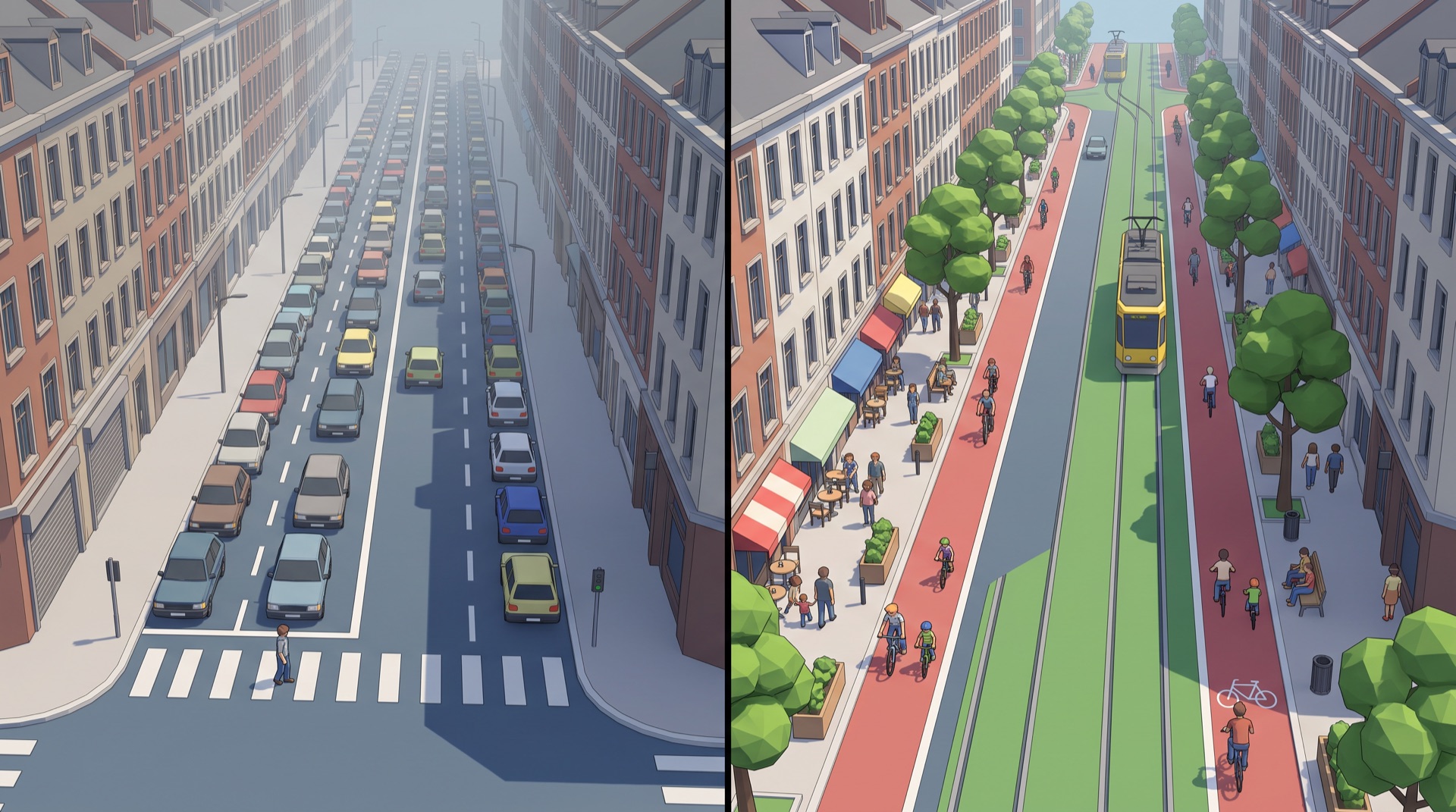
A street is judged by how many people it moves and how pleasant it is to be on, not by how many cars fit through it. A lane of mixed traffic moves about 600 to 1,600 people an hour. The same width moves about 7,500 as a cycle track, and 10,000 to 25,000 as a tram or bus lane (NACTO).
Every person in your town has somewhere to be. Each picks a way of getting there by how long it takes, what it costs, and how it feels: the wait at the stop, the hill, the crossing with no lights. You never set the bike share. It comes out of what you build.
Concept art: one street, before and after.
Paint is not a cycle lane
Most people would ride a bike if it felt safe. In the game, every street and crossing has a level of traffic stress from 1 to 4, and each person has a limit they won't go past. A route is only as good as its worst junction.
1A child can ride here
A cycle track kept apart from traffic, or a street where cars are rare and slow.
2Most adults will
A calm 30 km/h street, or a wide lane on a quiet road.
3Only the confident
A painted lane beside 50 km/h traffic, car doors on the other side.
4Almost nobody
Several lanes at 50 km/h or more, and you are in them.
1 Strong and fearless: ride anywhere
7 Enthused and confident: up to level 3
60 Interested but concerned: level 2 at most
32 No way, no how
Every way of getting there
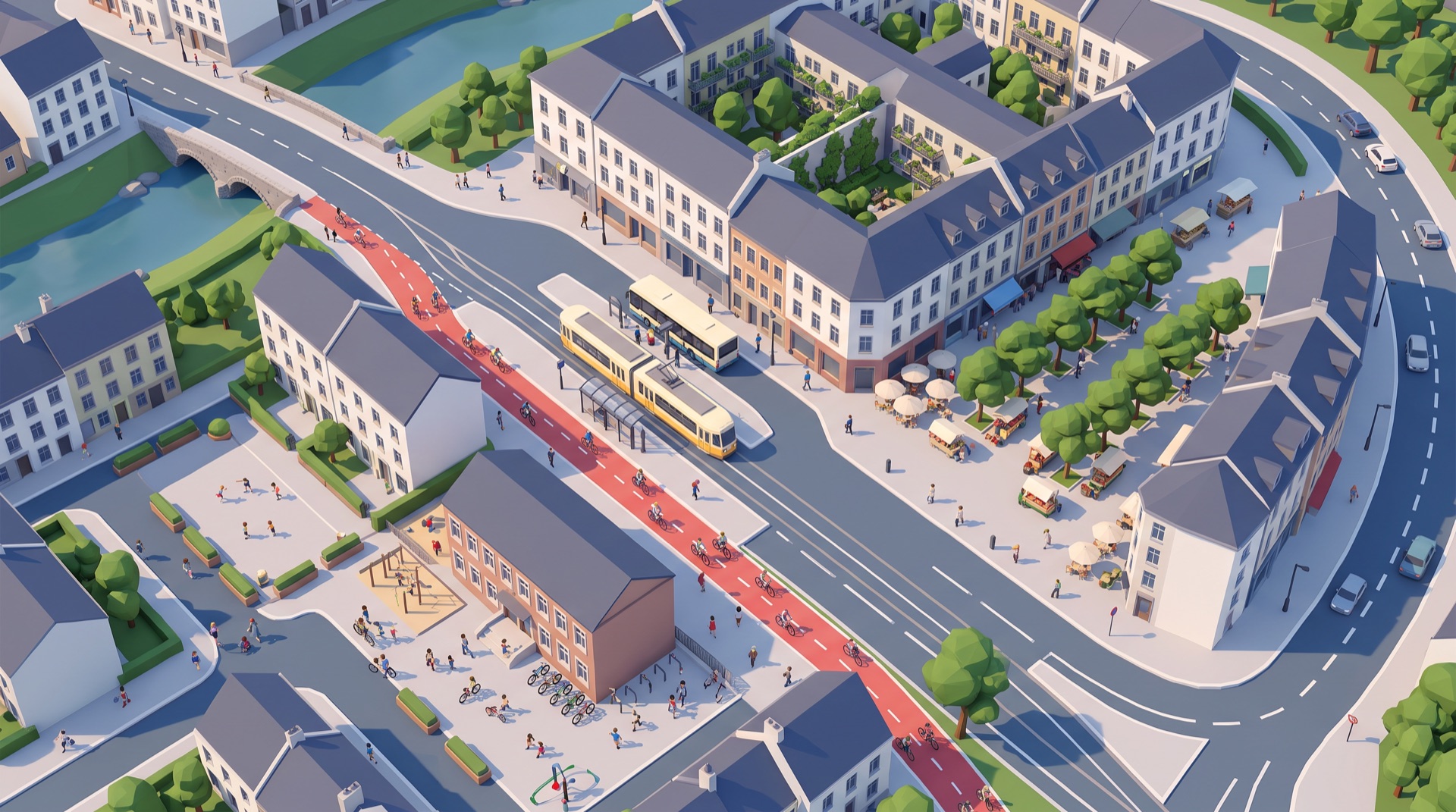
From a walk to the corner shop to a light-rail line across the region. Each mode needs its own space, has its own capacity and costs, and works best when it connects to the others: a bike ride to the station, a tram to the train.
The line gets thicker as the modes carry more people an hour.
Concept art: a town centre built for people.
Happy towns grow
People notice everything. Errands that take ten minutes instead of forty, trees outside the window, a quiet street at night, a child who can cycle to school without a parent. Each of these makes them happier, and happy towns attract people looking for a place to live.
And they live through every season. Clear the cycle tracks before the main roads after a snowfall and they keep riding in January. Light the park path and it's still used in December.
They also speak up. They ask for a crossing by the school, complain about the jam on the ring road, and protest when you take their parking away. Then, a year later, they say thank you.
Two ways to play
Build your own
Start with a few villages, a river and a railway halt, and design a town from the first street. Mixed-use from day one, streets laid out however the land asks, not on a grid.
Fix a car town
Take over a town built around the car: a through road splitting the centre, parking where the market used to be, children driven everywhere. Change it while people live in it, and win the next election too.
Where it's at
Getting There is in early development. It's made with Godot and will run in the browser as well as on the desktop.
Research and design. How people choose to travel, how good towns are planned, and the rules of the game.
Benchmarks. Can a browser simulate a town of 200,000 people? Now.
The street designer. Draw streets freely, give them cycle tracks and trees, and see their stress levels.
People and travel. Homes, jobs, schools, shops, and every trip between them.
First public playtest. Play in the browser, and report problems or planning feedback from inside the game, anonymously.
Growth and money. Budgets, land value, and the long-run cost of wide roads.
Public transport. Buses, trams, light rail, metro and trains.
Services and politics. Deliveries, schools, elections, protests and scenarios.
Polish. Architectural styles, from brick terraces and plastered tenements to Nordic timber and Mediterranean stone. Mix them district by district.