Appearance
How it plays
Getting There is a city builder where the traffic is people. You build the streets, the paths, the lines and the neighbourhoods. The people who live there decide how to use them. This page shows how those decisions work. It's the design as it stands; details will change as the game gets built.
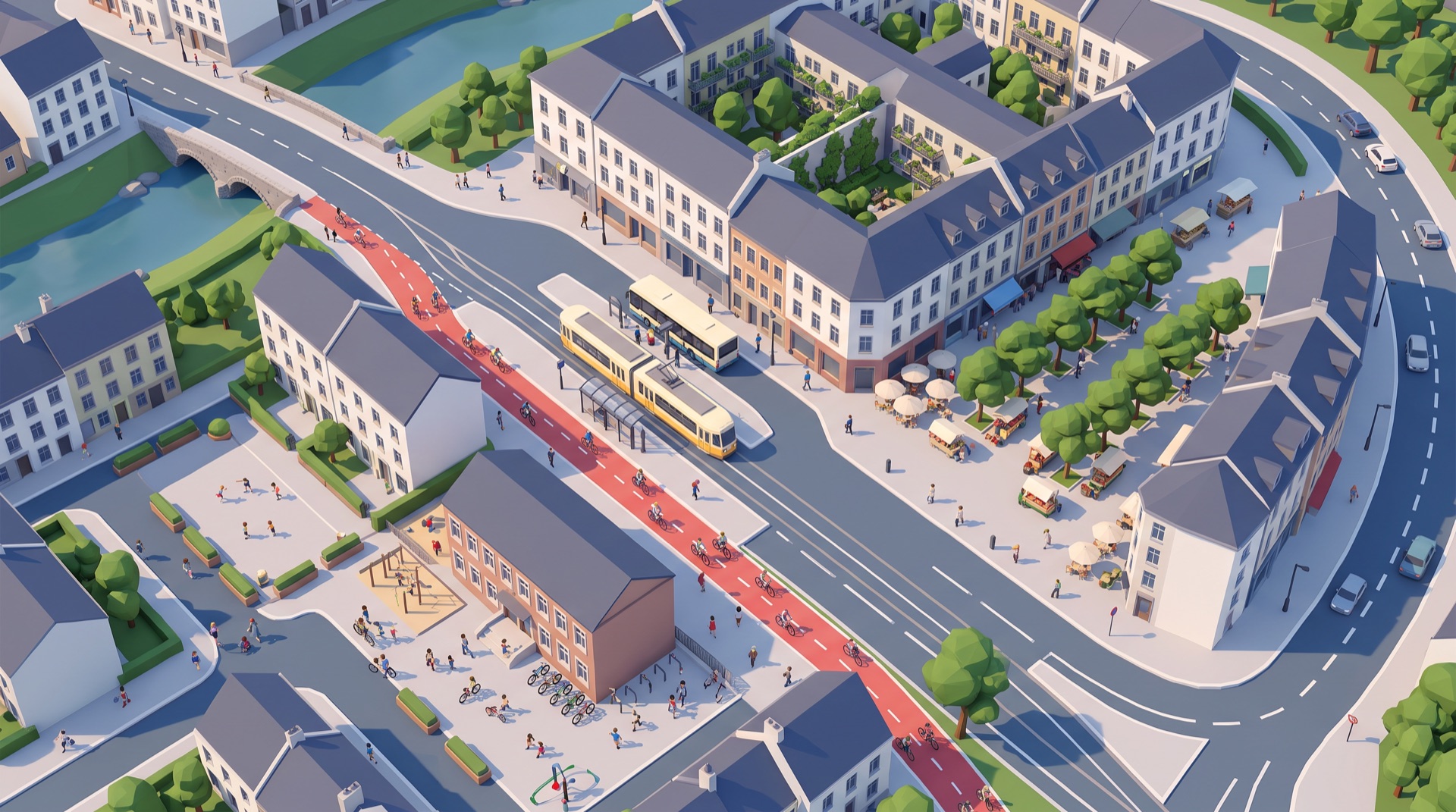
You build
Streets, drawn freely. Roads curve, fork and meet at any angle, following rivers and hills, not a grid. A street is a cross-section you can edit: pavement, trees, cycle track, parking, traffic lanes, tram track. Turning a four-lane road into a two-lane street with cycle tracks and a tram is one edit, plus the cost and the months of roadworks.
Every kind of street. Shared streets where children play, quiet residential streets, bicycle streets where cars are guests, main streets with shops, avenues, through roads and country lanes. What a street is for matters as much as how wide it is. A wide, straight street signed 30 km/h will be driven at 50.
Junctions. Priority junctions, roundabouts with a separate cycle ring, traffic lights with their own phases for bikes, protected crossings, underpasses, and modal filters: a few bollards that let bikes and buses through but stop through traffic.
Public transport, the full range. Buses, trolleybuses, bus rapid transit, trams, light rail, metro, suburban and regional rail, ferries and cable cars. Lines need stops, vehicles, depots and a timetable. How often they run matters most: every 10 minutes or better, and people stop checking the timetable.
Neighbourhoods. You don't zone residential, commercial and industrial. You paint the kind of place you want, from a village to a terraced street to a dense mixed-use centre, and decide how much of it is homes and how much is shops, offices and workshops. Schools, clinics, libraries, parks and markets you place yourself. Shops open on their own wherever enough people pass by.
Architectural styles. Build in brick terraces with stepped gables, plastered tenements round courtyards, Nordic timber, Mediterranean stone or modern mid-rise, and mix them district by district. A historic old town can grow a modern station quarter, the way real towns layer over time.
People decide
Everyone in your town has a household, a home, a job or a school, errands to run, and about an hour a day they're willing to spend travelling. For every trip they weigh up the options.
Time, but not all minutes are equal. Waiting for a tram feels about twice as long as riding it. So does walking to the stop. A change between lines costs the equivalent of five to ten minutes on top.
Money. Fares, fuel, parking and tolls, measured against what their time is worth to them.
Stress. Every street and crossing has a level of traffic stress from 1 (a child can ride here) to 4 (almost nobody will). Each person has a limit. About six in ten will ride a bike, but only where the whole route stays at level 2 or below. One nasty junction is enough to put a whole neighbourhood off cycling.
Habit. People don't change how they travel overnight. Routes change in days, the way to work in weeks, and whether a household keeps its car takes years.
Every season, every hour
The same street is a different place at eight on a January morning and at nine on a July evening. Rain and headwind make cycling harder for a day, and shelter and trees soften it. Summer heat makes shade matter. Winter commutes happen in the dark, so a park path without lights empties in December.
Snow and ice are your job. You run the ploughs and gritters and decide what gets cleared first: the cycle network and school routes, the tram corridors, or the main roads. That choice decides who gets to work the morning after a snowfall. A town that keeps its cycle tracks clear keeps its cyclists all year. Wet leaves in autumn and potholes after the spring thaw keep the crews busy the rest of the time.
Freedom for everyone
A good town lets people get around on their own, not only those who drive. The game tracks this for children, for older people, for disabled people and for anyone without a car.
A child goes to school on their own only if the whole route is safe enough for a child, short enough for their age, and their parents feel the neighbourhood is safe. Otherwise someone drives them, and that school run is part of the morning traffic.
Everyone else has needs of their own. Someone in a wheelchair needs dropped kerbs at every crossing, a pavement not blocked by parked cars, gentle slopes and a tram they can roll onto. Someone with sight loss needs tactile paving and crossings that beep. Someone who walks slowly needs a green light long enough to cross, and a bench every couple of hundred metres. A broken lift at a station, or snow left on a kerb ramp, cuts people off until it's fixed.
When the town fails them, someone has to drive them or a door-to-door minibus has to fetch them, and you pay for that every year. When it works, they go where they like, and so do the people who used to drive them.
Happy towns grow
Each resident has a wellbeing score made of the things that make a place good to live in:
- how much of their day goes on travelling and errands
- how pleasant and reliable their trips are
- what they can reach within 15 minutes on foot or by bike
- whether their children, or they themselves, can get around without a lift
- trees, parks, quiet and clean air
- how safe their street feels
- friends and neighbours nearby
- what their home and their transport cost
Happy towns attract people looking for somewhere to live, as long as there are homes for them, so growth depends on both. Unhappy residents complain, move away, and vote you out.
Money and politics
Wide roads are expensive to keep. Low-density, car-only suburbs often don't pay for their own streets and pipes, and the game shows it district by district. Transit costs money to run and brings in fares.
Everything you build wears out. Buses and trucks wear streets far faster than cars, and bikes barely at all. Fix things early and it's cheap; let them go and you rebuild at many times the cost. Potholes slow traffic, cracked cycle tracks put riders off, and a failing bridge gets a weight limit and then closes. The best moment to redesign a street is when it's due for rebuilding anyway, so a car town can be changed street by street as it wears out.
Big changes are unpopular before they're popular. Close a street to through traffic and the complaints come first, the cleaner air and busier shops a year later. Consultations and cheap trial versions (planters before concrete) soften the dip. Get the order wrong, taking parking away before the tram arrives, and it never recovers.
The planner's notebook
The game teaches by showing, not lecturing. Follow any person through their day and see why they made each choice: "would have cycled, but the crossing at the station is level 3". When you're stuck, the planner's notebook offers tips drawn from real towns:
- Build the network, not the line. A cycle track that ends at a dangerous junction carries almost nobody.
- Fix the crossings first. Most of the stress on a cycling route is at its junctions.
- Frequency is freedom. One line every 10 minutes beats three lines every 30.
- Put the homes and shops where the stops are, and the stops where the homes and shops are.
- Give people a better way before taking the old one away.
- Bike parking at the station grows the station's reach from a 10-minute walk to a 15-minute ride.
- More lanes fill up. Fewer lanes empty out, and the traffic doesn't all go somewhere else.
- A street children can play in is a street everyone likes living on.
Goals
Scenarios set you a problem: calm a town where children are being hurt on the roads, build a new town where most trips aren't by car, or remove a motorway from the centre without gridlock. Sandbox play has milestones that ask for more than population: a town only becomes a city once most people can reach their daily needs within 15 minutes. Achievements reward the moments that surprise people, like closing a road and finding the traffic got better.